Showing posts with label French Fridays with Dorie. Show all posts

Saturday, July 27, 2013

The French Paradox & Dieter's Tartine


Periodic makeovers are necessary for any diva.  A freshening of the wardrobe, make-up and hair—maybe even a little attitude adjustment-- is needed at least once a year, but preferably seasonally as the weather changes.  A diva cannot get stale; nor should her website.  So that is why Confessions of a Culinary Diva is getting a make-over.  My stylist is the talented Evy Hanson, owner of Leap Online Marketing , and she is helping me create a new and vibrant website that will embrace my varied interests.  Confessions of a Culinary Diva will have more lifestyle content as I share with you travel and restaurant recommendations and experiences, culinary and travel book and product reviews--trust me the  Vitamix is worth the money and I will tell you why-- fashion tips, and things to do if you find yourself in Southern California, particularly the Palm Springs area.  The new website should be up and running soon, but in the meantime let’s continue our culinary journey through Around My French Table by Dorie Greenspan.

”Diet” is a nasty four letter word that makes me cringe and conjures visions of unpalatable food, miniscule portions, and cardboard packaging.  While it is something I should be doing, a diet is a grim prospect for someone who adores cocktails, wine, cheese, bread, cream, and butter.  Imagine my surprise when this week’s “French Fridays with Dorie” challenge was “Dieter’s Tartine”.  Tartine and diet used in the same sentence – a bit of an oxymoron in this day and age when bread, gluten, wheat and just about anything we enjoy should be purged from our diets. 


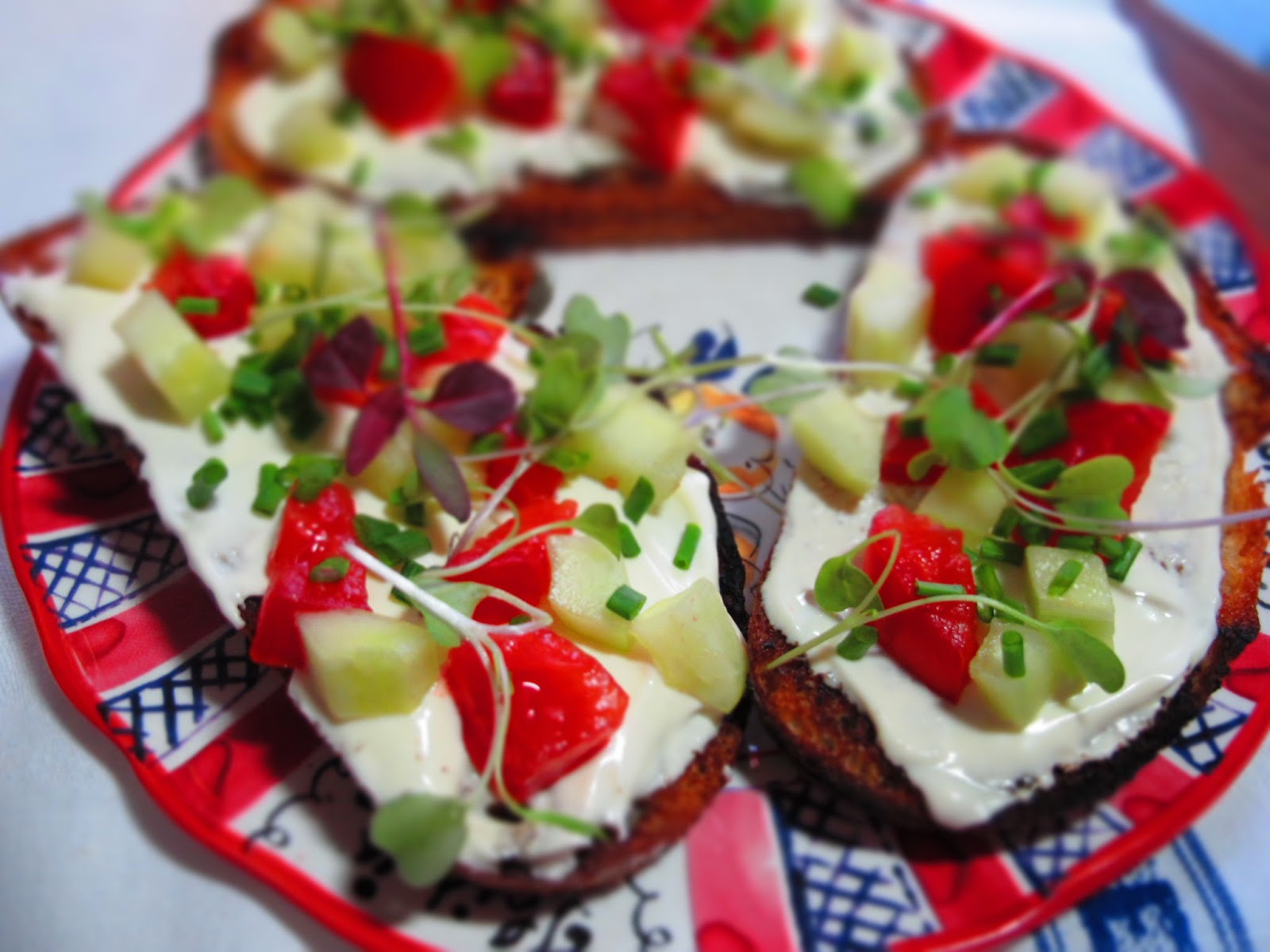
This recipe falls into what I classify as the “no recipe needed recipe.”  Just grab a fresh loaf of French bread and a few fresh veggies to dice.  Slice the bread and grill or toast it.  Spread on some fromage blanc, crème’ fraiche’, sour cream, or cottage cheese.  And top with diced veggies–-cucumber and tomato are recommended--along with a sprinkling of herbs and chives.  You decide which veggies and toppings to use and, Voila!, lunch is served.

Whether on a diet or not, the Dieter’s Tartine is sublime.  Not only is it easy to make, you may delude yourself that this is actually a “diet” food Jenny Craig or Nutrisystem might endorse.  After all, fresh veggies are a main component to the toppings that are slathered onto a piece of grilled, crusty, country-style French bread.  Fortunately, the French have a sensible approach to “diet,” with moderation not elimination being the key element.  So I declare this French dish to be so salubrious that it must be accompanied by a glass of chilled, crisp, dry rose from Provence.  The French Paradox minus the cigarette should be observed to get the full effect of this “diet” food.


To learn what other Doristas think about the “Dieter’s Tartine,” visit French Fridays with Dorie.


Wednesday, July 24, 2013

The Bumbler & The Beast - Norwegian Wolffish


From my perspective, it was a matter of beauty and the beast, although the beast part was not readily apparent from its packaging and beauty is always subjective and sometimes fleeting.  From my sous chef’s perspective, it was a matter of the bumbler and the beast.

While rummaging for swordfish in the frozen foods section of Trader Joe’s, I came across one of those “special” TJ foods that often pique my curiosity.  You know the kind:  something totally unknown or, at best, vaguely familiar, but marketed by TJ to sound intriguing, adventuresome, and edible, if not delicious. 

Does anyone know a good dentist?
 Alas, TJ had no swordfish (which I could not believe since I normally wade through piles of it when looking for other fish), but it did have spotted Norwegian Wolffish (Anarchichas Minor) that, according to a TJ stockman serving that moment as an enlightened fishmonger, would be a good substitute.  The package he handed me had an appealing label that showed the Wolffish in profile (clearly its best viewpoint as the photos demonstrate) and identified it as having meat that was white and firm and a taste redolent of lobster, crab, and shellfish.  Plus it can be cooked in a number of ways:   baked, fried, grilled, poached, steamed or sautéed.  It all sounded good to me, so Norwegian Wolffish would stand-in for swordfish in this week’s “French Fridays with Dorie” cooking experience.       

 
Julia handled Monkfish much better than I do Wolffish

Not your average lap pet

According to TJ and other online sources, the Norwegian Wolffish is a sharp toothed, cold water fish whose flavor derives from its diet of shellfish, such as mussels, scallops, sea urchins, and crabs.  Norwegian Wolffish is known to reach lengths of up to 7 feet and weigh up to 40 pounds.  Their fang-like teeth are part of a rather stout head and large mouth, all the better to dislodge mollusks and crustaceans from their familial homes on the rocky bottoms of near freezing deep waters like the Barents Sea above Norway or to dismember the fingers of careless fisherman.  Despite its dental and facial shortcomings, the Anarchichas Minor variety is quite fashionable with leopard-like spots on its scale-less, silky-smooth skin.  Armed with two fillets of this beast, I strode from TJ’s determined to make a dish worthy of Dorie’s praise.

This week’s recipe from Around My French Table by Dorie Greenspan is very simple:  sautéed or grilled swordfish served with an herb salad tossed with a splendid Dijon vinaigrette.  This is something that can easily be whipped up after a long day at the office and gives the impression that you are eating light and healthy.  And for those who used swordfish or did not suffer a culinary brain cramp, it probably was all those things Dorie intended.

Looks can be deceiving 
Out of necessity, inquisitiveness, or downright contrariness, I often substitute ingredients, usually with good results.  But my experience with Norwegian Wolffish reminds that there are a number of universal cooking guidelines that should always be observed.  First, make sure that what you substitute does not compromise the integrity of the recipe.    Second, check cooking times and methods for the substitute since they may not be the same as for the original.  Third, when defrosting frozen fish, follow the instructions on the package.  If there are none, at least take it out of its original packaging, pat dry, place on a plate, cover with plastic wrap, and leave it in the refrigerator overnight.  Defrosting in the original packaging causes the fish to absorb lots of unwanted and likely unpleasant liquid.  Fourth, when you want fish to have a crispy skin, dry the skin first, cook in a hot pan, add the fish to the pan skin side down and, using a flexible spatula, press on the flesh until the fillet flattens out (this makes sure all the skin is in contact with the pan), and don’t flip back and forth, just let it cook on the skin side until the last couple of minutes when you can finish on the flesh side.   

Rafa is looking for a better recipe and instructions
I most certainly violated guidelines two, three and four.  Guideline Two:  Dorie’s recipe calls for a seven minute sauté whereas TJ’s recipe calls for twenty minutes baking in the oven.  I sautéed for seven minutes and it was not enough.  Guideline Three:  I defrosted overnight in the airtight packaging and the fish was swimming in liquid the next day.  Guideline Four:  I cooked the fish flesh side down for the most part.  The result was a tough, slimy, unpleasant looking skin, an undercooked fish with areas that looked and felt gelatinous, and none of the succulent flavors of lobster or other shellfish that I was craving.  Lesson learned and I will give the Norwegian Wolffish another try.  At least the salad was excellent.  

Saturday, July 13, 2013

Kitchen Therapy - A Glass of Rose' & Savory Clafoutis


Gallup has recently confirmed what everyone knows:  70% of us don’t feel positively about our source of daily bread.  And by that they don’t mean our local bakers but our gig, our grind, our old 9-to-5.  The best thing about a vocation is a vacation, but an avocation can lead to many pleasurable hours and experiences.

As a culinary diva, food and beverages are my avocation, a status I would upgrade to vocation in a blink if I could thereby support sous chef and me.  That seems unlikely, however, so I pursue my passion in many ways:  restaurants, bars, wineries, farmers markets, food blogs, and the like.  Yet perhaps my favorite pursuit is cooking.  Not the sweaty, neurotic kind of cooking done in a restaurant or the frenzied kind of cooking for dinner parties or large groups.  But the serene, agreeable experience of trying new recipes or crafting old ones in clever and delectable ways, all in the comfort of one’s own kitchen.  What a great way to unwind after a day of drudgery—and it certainly does not hurt to have sous chef provide me with a glass of chilled French Rosé before the cooking begins (and refills as it proceeds). 


My sous chef and I love the challenge of using a favored dish as a platform for other dishes.  There is something about the inventive use of familiar fare that is fundamentally rewarding.  I would be pleased as punch to be known as the “MacGyver of the kitchen,” so I was thrilled that the sweet, luscious Cherry Clafoutis I wrote about in June can easily be turned into a savory delight.  I took the base recipe for Clafoutis, omitted the sugar, exchanged heirloom cherry tomatoes for the cherries, and added some fresh basil and cubed cheese to the mix.   The result was a Savory Clafoutis that can be served on its own as a first course, as a side to a brunch, or as a light lunch with an herb infused salad. 


The combinations and permutations for the little Clafoutis are seemingly endless.  Crave some pork fat:   just add bacon or pancetta.  Feeling Greek:  combine olives and feta with the tomatoes and garnish with some freshly diced cucumber and dill.  Fromage lover?  Go for it!  The base Clafoutis is the perfect canvas for mild to strong cheeses to shine.  Heck, why not have a Clafoutis party?  Fix up a batch of Clafoutis batter and let the guests add their own ingredients to make them sweet or savory.  


Savory Clafoutis

Batter:

4 eggs
¾ cup of sugar
Pinch of salt
Scant ½ cup ground almonds
2 Tbs all-purpose flour
7 Tbs creme fraiche (can substitute sour cream)
 7 Tbs Buttermilk (or regular milk)


Filling:

1 container Mini Heirloom  Tomatoes
1 cup diced cheese of your choice
2 spring onions diced
Chopped fresh herbs of your choice

Bread crumbs

Preheat oven to 350 degrees.

Butter and flour 6-8 ramekins or one 7 ½ by 4 inch baking dish or pan.  (I used bread crumbs that I had seasoned with garlic, black pepper and sea salt, in place of flour in the ramekins.)

Place tomatoes evenly across bottom of the prepared ramekins or dish.

Whisk the eggs with sugar and salt until pale yellow and thick. Sift and fold in the ground nuts and flour, then stir in the crème fraiche.   Add cheese, spring onions and freshly chopped herbs.  Make sure the ingredients are well mixed.

Pour or ladle the batter over the tomatoes, place the ramekins or dish on a baking tray, and bake for 30-40 minutes until golden brown.

Interested in reading more experiences with Cherry Clafoutis?  This week the Dorista's over at French Friday's with Dorie have a gaggle of experiences to read about.

Friday, May 4, 2012

Hook, Line and Sinker


I am not aware of any flounder, or its relation sole, making it up the All American Canal to the Coachella Valley.  Maybe that’s because being a flatfish with two eyes on the same side makes navigation difficult.  Or more likely they don’t cotton to our desert clime.  So we are at the mercy of local fishmongers who occasionally truck a limited amount of fish in from Los Angeles.  Apparently flounder is not a desert favorite as none of the local fishmongers had any in stock.  After my sous chef’s patience was tested to the breaking point, we settled on a duo of related flatfish:  petrale sole and dover sole (the Pacific variety—not the real thing from off the coast of Great Britain). 

A piece of Modern Art - mixed media
To make this week’s French Fridays with Dorie challenge even more interesting, my creative sous chef suggested we do a wine tasting between Vouvray and Sancerre to determine which was the best pairing for the light, delicate fish we were about to prepare.  I am always in favor of tweaking the challenge, particularly when it involves quaffing some very good wines.  For the tasting we chose a 2009 Marc Brédif Vouvray and a 2009 Les Tuilières Sancerre.

Painting the Sole with egg - the color of this egg is so bright and sunny

We rarely cook fish at home.  First, we don’t have a great retail source for fresh fish, second, my sous chef is adverse to fish smells in the house and, third, we think restaurants do a better job cooking fish than we do.  So we generally confine our fish consumption to restaurants.  Neither of us has ever knowingly consumed flounder, but we each have enthusiasm for the sole family of flatfish.  My sous chef waxes poetic about the petrale sole served at The Tadich Grill in San Francisco.  And I am a huge fan of the sole dishes prepared by Chef Bernard Deverieux at his restaurant, Cuistot, in Palm Desert.  Chef Bernard is a classically trained French chef, so he knows a thing or two about the preparation of sole. 

Coated both sides of the Sole
Our concerns about preparing this week’s recipe were quickly dispelled.  This is one of the simplest meals I’ve prepared in my life.  Prep time was about 3 minutes and, with only 6 minutes of cooking time, dinner can be on the table in less than 15 minutes making it a perfect weeknight meal.  That is less time than it takes to order and pick up food at the local pizza joint.  And my sous chef discerned no unpleasant fish odors.

Cook 3 minutes per side in butter 
 The fish was delectable - moist, firm and succulent.  I ground slivered almonds in the food processor and left it more grainy than powdery to give the coating more color and texture.  The result was a crispy, visually appealing crust that I thoroughly enjoyed but which my sous chef felt overwhelmed the delicate flavors of the sole.  He likely would feel differently if we had used halibut as a flounder substitute since the addition of flavor would be welcomed.  We did agree this coating would make a great crust on chicken or turkey and would be better if ground more finely when used on fish.  This coating is a winner and I fell for it hook, line and sinker.

The almond crust is really fragrant with the lemon zest
There was no real winner in the wine tasting competition as both wines were excellent and worked well with either the petrale sole or the dover sole.  Although clearly siblings, there were some differences.  The Vouvray had a slightly floral nose with a  small touch of honey in taste – delicate like the fish.  Whereas, the Sancerre was crisp with a little gravel hint on the palate and utterly wonderful for the richness of the fish.  I recommend you do your own taste test.  There is no reason to limit yourself to one bottle of wine with this fish recipe.

Rhubarb Custard Pie with a little French Vanilla Ice Cream (it is French Friday after all)
To complete our meal, I made a favorite dessert that presented a nice contrast of flavors to the fish that preceded it.  I love rhubarb in many iterations, but an absolute favorite is Rhubarb Custard Pie.  Pre-Culinary Diva, my Southern California born and raised sous chef had never been exposed to a rhubarb, except during his baseball playing days.  Fortunately, he has taken a liking to the sour, tangy, sweetness of the vegetable, which allows me to indulge my rhubarb passion throughout the summer.   

Sous Chef wanted me to describe the size of the chopped rhubarb, this looks about 1/2 inch to me

This recipe originates from my grandmother, and I have adapted it slightly to my taste by including more rhubarb.  

Rhubarb Custard Pie

4 to 4 ½ Cups Rhubarb
1 Cup Sugar
2 Tablespoons All-Purpose Flour
3 Eggs

Preheat oven to 350.

Rough chop the rhubarb into half-inch pieces and place in bowl.  Add sugar, flour, and eggs to bowl with rhubarb and stir until all ingredients are combined.

Line pie plate with pie crust (use ready-made or make your own).  Place rhubarb mixture in pie crust, and top with pie crust.  Poke holes with fork or knife to vent crust while baking.  Place in oven. 


Bake approximately 45 minutes.  After 30 minutes of baking, rub top of pie crust with butter and sprinkle a little sugar on crust.  Bake another 15 minutes and check for doneness.  When pie is done, remove from oven to cool.

To read more French Friday with Dorie experiences, or to buy the book:
www.frenchfridayswithdorie.com


It's sort of like a Dump Cake but a Dump Pie - put it all in a bowl and mix well
  
I vent the bottom crust with a few pricks of a fork before putting the mix in

Top crust on and vented
Flaky, sugary, golden crust combined with the tart Rhubarb makes for a perfect medley

Friday, April 20, 2012

The Presbyterian and Pina Colada Friand


It could take a fortnight to debate whether a “Coconut Friand,” this week’s French Fridays with Dorie challenge, is a “French Friand,” a “Financier” or an “Australian/New Zealand Friand.”  No matter the derivation, it is a tea cake, and this makes me think of High Tea at The Empress Hotel in Victoria or Afternoon Tea at Brown’s Hotel in London.  Those occasions when we Americans try to act cultured, pinkies extended, as we sip tea and eat insipid, crustless cucumber finger sandwiches and cloyingly sweet dessert delicacies when what we really want is a strong libation after a day’s shopping and sightseeing.

Around my French Table is a staple in our kitchen
 I have become a California girl and my sous chef is a Los Angeles native.  When we hear the word “coconut” we think of crashing waves, balmy breezes and swaying palm trees, not some cute tea cake.  Give me a chair overlooking the ocean, a cocktail in hand and Jimmy Buffet on the radio and I am in heaven.  In this sunbaked part of Southern California--we have already reached 100+ degrees—it is pleasant, if not essential, to introduce the tropics into our lives whenever possible.  So I decided to create a culinary libation based on one of my favorite tropical drinks.  Ergo, the “Piña Colada Friand.”

Lightly whisk egg whites until slightly foamy


Whisk in all ingredients, being particularly gentle with flour and melted butter
The batter is super easy to prepare and can be made up to 3 days in advance.  To create this culinary libation, I took a few necessary liberties in augmenting Dorie’s recipe by adding lime zest, dark rum, and vanilla fleur de sel and using a combination of sweetened and unsweetened shredded coconut.  I put a fresh pineapple square in the bottom of each paper cup in the mini-muffin tin before pouring in the batter.  I placed the mini-muffin tins on baking pans and put them into a preheated 350 degree oven for 8 minutes, at which time I rotated the baking pans and baked for another 8 minutes.  I then removed the paper cups and let the friands cool on a baking rack.  Viola!  A “Piña Colada Friand.”

Who put the lime with the coconut????

A little pineapple for our daily fruit intake...hey, it's worth a try to make this a "health food"

24 Pina Colada Friands ready for baking

The friands looked a little naked, like the men at Muscle Beach in Santa Monica, so I decided a cover-up was needed.  I made a simple glaze from confectioner’s sugar and coconut milk and toasted some shredded coconut for color and texture.  After the friands had cooled slightly, I drizzled on the glaze and sprinkled on the toasted coconut.  The Piña Colada Friands now looked properly clothed and ready to party.

Poolside, waiting for that afternoon tea.....

Teetotalers beware!  These friands deserve more than hot tea.  An ice cold Piña Colada is a natural pairing, but I am an aspiring mixologist diva and the simple way is not my way, for better or for worse.  After many trials and a handful of Tylenols, I found the perfect cocktail accompaniment:  The Presbyterian.  This drink is not for choir boys and, despite its name, its consumption need not be limited to Sunday brunches. 


The Presbyterian
(Adapted from a demonstration by Mark Peel of Campanile at Palm Desert Food & Wine 2012)

2 Ounces Rye Whiskey
1 Ounce Simple Syrup
1 Lime freshly squeezed
Ginger Beer to top off
Ice

Place the rye whiskey, simple syrup, and lime juice in a cocktail shaker.  Fill with ice and vigorously shake.  Fill a glass (preferably a Collins glass) with ice and pour, leaving about one inch room so you can top off with Ginger Beer.


This makes a light, refreshing cocktail that goes perfectly with the Piña Colada Friands.  So make a pitcher of Presbyterians, grab a handful of Piña Colada Friands, crank-up the volume on Margaritaville and enjoy.

To read more French Friday's with Dorie or to join the group:

www.frenchfridayswithdorie.com

Thursday, April 12, 2012

Dr. Seuss and The Big Tuna Agree: Tuna Rillettes are a Winner


I am the Culinary Diva.
A Culinary Diva I am.

I do not like Sardines,
Culinary Diva that I am.

I do not like them in a tin,
I would not like them here (Sardine Rillettes)
Or there (Around My French Table).

I would not like them anywhere!”

-adapted from Green Eggs and Ham by Dr. Seuss

Childish as it may seem, I do not like sardines!  Dress them up, disguise them, no matter:  I don’t like them.  Not even if they are a featured ingredient in my treasured cookbook Around My French Table by Dorie Greenspan.

What’s a culinary diva to do?  I want to fit in; I want to follow the rules.  But at the very sight of this slimy, disgusting little bait fish I break out in hives and hot flashes.  Who knew you could have an allergic reaction just by viewing a sardine based dish on a computer screen?

In the spirit of this week’s French Fridays with Dorie challenge, I decided to make the Tuna Rillettes instead.  While the Big Tuna, Bill Parcells, won’t likely be with the Saints, this tuna dish is heavenly and amazingly simple to make within five minutes. 

Pantry staples make for a delectable treat
You will likely find the ingredients in your pantry.  And, if not, you haven’t been shopping lately.  Just take some canned or packaged tuna, add curry powder and some other spices and, voilà,
Save a step and put directly into food processor and not separate bowl like I did
 The franchise player is the curry and my star was the Japanese Curry from Williams Sonoma.  Not only is there an amazing aroma, but the subtle nuances from the curry (star anise, cayenne pepper, cumin, black pepper, fenugreek, turmeric, fennel, and coriander) played well with the tuna.  The curry did not overwhelm the palate or the tuna, but it did create a medley of flavors.  Although the recipe calls for allspice, shame on me and my grocery shopping sous chef but our pantry was bare in this regard so I decided to use a little pumpkin pie spice instead.  Happily this substitute performed like Matt Flynn, formerly of the Green Bay Packers and now with the Seattle Seahawks (at least according to my sous chef who is counting the days until football season begins).  Plus I opted for heavy cream over the crème fraiche (because of a refrigerator shortfall), and was very pleased with the texture and richness it added.  A little squeeze of lemon brightened the flavors as it always does.
Squeeze a little lemon juice

I love my Little Pro Plus - it's great for Rillettes,
So what is the perfect canvas for this delectable dip?  Raincoast Crisps!  We used the Fig and Olive and the slight sweetness of the fig complimented the curry.  Celery would also be a great vessel to enjoy the goodness of this rillettes.
Tuna Rillette with Raincoast Crisps
 

My sous chef thought this might be Dorie’s best recipe so far, certainly better than the Crab and Grapefruit Salad we tried before it.  He gave it two corkscrews up as a wonderful appetizer that is perfect for Spring, Summer and Fall picnics (Hollywood Bowl here we come!) and for a light meal when you don’t feel like cooking.
The unfortunate Crab & Grapefruit Salad is still a work in progress
(note, do not substitute Sambal for hot sauce with this dish)
To read more French Friday's with Dorie, or to join in on the fun:


www.frenchfridayswithdorie.com


Friday, April 6, 2012

The Bishop's Choice - Asparagus with a Wee Bit of Bacon


What does an asparagus spear resemble?  Exactly:  a bishop on a chessboard.  And like the chess piece, when used correctly it is potent but not overwhelming.  (Pardon the ecclesiastical reference, but it is Good Friday.) 

Asparagus has been cultivated for over 2500 years and is one of my favorite vegetables to grill, steam, or wrap with a little prosciutto as an appetizer.  Asparagus is approximately 4 calories a spear, provides 60% of the recommended daily folicin intake (necessary for blood cell formation, growth, and prevention of liver disease), and is a natural diuretic, making it great to consume when you are trying to lose a little bloat before big events.  For me, like the lily—of which it is or was a family member—asparagus is synonymous with Easter and Spring.  If you don’t believe me, look in this month’s issue of any food magazine and you will see lilies on the table and asparagus on the plate.
Bacon bits, onion, and olive oil may increase the calorie count of asparagus
 This week’s French Fridays with Dorie challenge is “Asparagus with Bits of Bacon” (as well as onion and lemon).  Bacon is a natural pairing with the slightly acidic flavor of asparagus, onion goes well with everything and lemon brightens the flavor of any green vegetable.  I’ve made this combination many times, although I veer slightly from Dorie’s technique.  She cooks the asparagus in water for approximately 4 minutes before adding to the bacon and onion mixture while I skip this step and place the asparagus directly into the pan with the bacon and onions.  This saves clean-up of an additional pan—a benefit for my sous chef who already thinks me a messy cook—and cooks the asparagus just fine. 
Add Asparagus & Lemon to bacon mixture
 We paired this dish with a veal rib chop and a gorgeous Anthill Farms--Peters Vineyards--2007 Sonoma Coast Pinot Noir.  This wine is Burgundian in style, lean and earthy with subtle undercurrents of the California terroir.  It is delicious with food ( i.e., not meant for quaffing as an aperitif), and with only 13.5 percent alcohol your head will appreciate the difference in the morning.

Since this week’s recipe was not very challenging, I decided it was time to go off-reservation a bit and use the ingredients in a more interesting way.  Since grilling season in the desert is officially underway, a pizza on the grill sounded like a perfect way to use the ingredients and have a little fun doing so.
Arugula Pesto
I made an Arugula Pesto for the sauce.  The bite and peppery spice of the arugula was the perfect base for the asparagus, prosciutto (substituted for bacon), onion and lemon combination.  Note that I did not include lemon juice in my pesto for, in combination with the lemon slices, it would overwhelm the flavors of the ingredients used as toppings.    
Toppings ready for the grill

This grill basket from Williams Sonoma is essential for grilling and one of my most used items
 I just love the flavors imparted by grilling.  So into a grill basket went the asparagus, onions and lemon slices.  My sous chef thought that a little grilled chicken would be a nice addition, so while the vegetables cooked I charred some boneless, skinless chicken breasts.  In less than 20 minutes, my chicken and vegetables were ready to be used as pizza toppings. 
Pizza dough placed on hot grill - see how it starts to bubble almost immediately

After about 3 minutes of grilling - lots of bubbles

Flip the dough - now ready for toppings
 Pizza dough is simple to make at home, and only needs about 30 minutes to rise before you roll it out into the desired shape.  But if you find yourself short on time – as I was--Trader Joe’s makes a great pre-made pizza dough.  To make pizza on the grill, simply roll out the dough into the desired shape/size and lightly rub each side with olive oil so it does not stick to the grill.  Place the dough on a preheated grill (I left my grill on after making the toppings, so it was preheated to its max temperature of 600 degrees).  With the lid open, cook one side until the dough starts to bubble and easily lifts off the grill (3-5 minutes).  Flip it over and push down gently to remove the bubbles from the top and bottom surfaces.  The dough is now ready for the addition of the toppings.
Juicy, sliced grilled chicken breast

Pizza Party!  Toppings ready for take off!
 First, add the sauce of your choice and then spread your desired toppings over the sauce.  For my pizza, I used the Arugula Pesto and then added some grilled chicken, some of the grilled asparagus, onions and lemons, a little prosciutto, mushrooms and pear slices for a delightful surprise.  If you desire cheese on you pizza, find a good melting cheese.  We are trying to cut calories in our house, so I just shredded a little parmegianno reggiano on the top.  Once the toppings are on, put the lid down and cook for approximately 4-5 minutes to heat ingredients through.  When the pizza is done, you can garnish with an additional shaving of cheese and a sprinkle of fresh greens.
Begin by layering toppings

Ready for cheese shavings

Making pizza on the grill can be interactive, so it can make for a terrific dinner party activity.  Just pre-make, shape and cook the dough and let everyone customize and finish their individual pizza.  It’s kind of a DIY Party! 
 

Arugula Pesto:

Makes 1 Cup

20 Arugula leaves
1/3 Cup Chopped Walnuts
3 Cloves Peeled Garlic
¼ Cup Extra Virgin Olive Oil (you can add extra if you want thinner pesto)
Salt to taste

Place in food processor or blender and blend until desired consistency.

To read more French Friday with Dorie experiences:

www.frenchfridayswithdorie.com


The Irish Soda Bread I haven't posted about but made in between matches of Rafa & Roger

Rafa Nadal - need I say more?  Vamos Rafa!